How to Adjust the Drag on a Baitcaster
Here is how to adjust drag, explained in simple, tested steps.
Quick answer: Set a baitcaster‘s drag to about one third of your line’s rated strength. Turn the star drag toward you to tighten and away to loosen, then pull line off by hand to test. Too tight breaks light line on a hard run, and too loose lets fish reach cover.
Key takeaways
- Set drag to roughly one third of your line strength as a starting point.
- The star drag is the wheel behind the handle. Turn it to adjust.
- Drag is not the same as spool tension. People often confuse them.
- Test by pulling line off by hand until it feels firm but gives.

Drag is the part of the reel that gives line to a running fish so your line does not snap. Set it wrong and you lose fish, either by breaking off when it is too tight or by letting a fish reach cover when it is too loose. Set it right and the reel does its job during the fight. This guide shows you how.
You learn the simple rule for setting drag, how to test it, and why it differs from the spool tension knob. The advice reflects standard tackle guidance.
Find the Star Drag
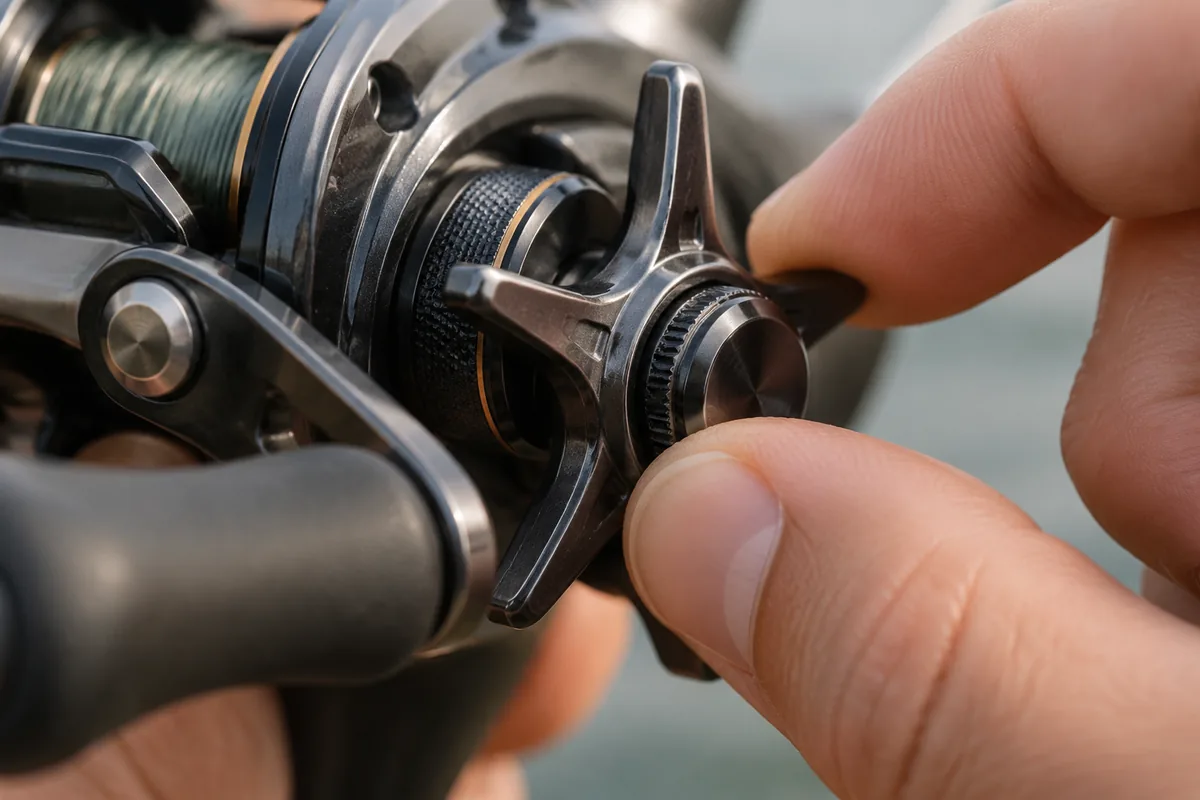
The star drag is the star shaped wheel tucked behind the reel handle. Turn it toward you, or forward, to tighten the drag, and away from you to loosen it. This wheel sets how much pressure a fish must pull against before line slips off the spool. It is separate from the spool tension knob on the side.
The One Third Rule
A good starting point is to set the drag to about one third of your line’s rated breaking strength. So with 15 pound line, aim for around five pounds of drag pressure. This gives enough resistance to control a fish while leaving a safety margin so a hard surge does not snap the line.
| Line rating | Rough drag target | When to adjust |
|---|---|---|
| 8 lb | ~2.5 lb | Loosen near cover |
| 15 lb | ~5 lb | All around bass |
| 30 lb | ~10 lb | Heavy cover, big fish |
| 50 lb braid | Firm, near max | Frogs, punching |
You do not need a scale. Set the drag, then pull line off the reel by hand. It should feel firm but give steadily under a strong pull. If it feels locked, loosen it. If line slips too easily, tighten it. Adjust until it feels right for the fish you chase.
Drag vs Spool Tension
These two knobs confuse many new anglers. The star drag controls how line gives to a fighting fish. The spool tension knob, on the handle side of the reel, controls how freely the spool spins during the cast to prevent backlash. They do different jobs. Set the spool tension for casting, and the star drag for the fight.
Adjusting During the Fight
Set your drag before you cast, but do not be afraid to adjust it during a fight. If a big fish runs toward cover, a slightly firmer drag turns it. If a fish surges near the boat on light line, easing the drag prevents a break off. Learn to feel the fight and make small changes. A smooth drag makes this easy.
Frequently asked questions
How tight should baitcaster drag be?
Set it to about one third of your line’s rated strength as a starting point. Then pull line off by hand. It should feel firm but give steadily. Too tight snaps line on a run, too loose lets fish reach cover.
What is the one third rule?
The one third rule sets drag to roughly one third of your line’s breaking strength. With 15 pound line, that is about five pounds of drag. It gives control while leaving a safety margin so a hard surge does not break the line.
Star drag vs spool tension?
The star drag, behind the handle, controls how line gives to a fighting fish. The spool tension knob, on the side, controls how freely the spool spins during the cast. They do different jobs, so set each separately.
Why does my line keep breaking?
Often the drag is set too tight, so a hard run snaps the line instead of giving. Loosen the drag to about one third of the line strength, test it by hand, and adjust down if a fish breaks off on a surge.