Magnetic vs Centrifugal vs DC Braking Explained
This guide covers the baitcaster braking systems with hands on, tested picks.
Quick answer: Baitcaster brakes control spool speed to stop backlash. Magnetic brakes adjust easily and suit beginners. Centrifugal brakes give strong early cast control for wind and heavy lures. DC brakes use a chip to adjust automatically. Many reels combine magnetic and centrifugal for the most tuning range.
Key takeaways
- Brakes slow the spool so it does not overrun your lure and tangle.
- Magnetic brakes adjust from the outside and suit new casters.
- Centrifugal brakes act hardest early in the cast, good for wind.
- DC braking adjusts automatically with a tiny circuit.

Every baitcaster has a brake, and it is the part that keeps your line from turning into a bird’s nest. Yet most anglers never learn how it works. Understand the brake, and you cast farther with fewer tangles. This guide explains all three types in plain terms.
You learn what each brake does, when in the cast it acts, and which suits your fishing. The explanation leans on how the systems actually function and how makers like Shimano and Daiwa describe them.
Why a Baitcaster Needs a Brake
When you cast, the spool spins to release line. The lure pulls line off at the start, then slows as it flies. If the spool keeps spinning faster than the lure pulls line, the extra line piles up into a backlash. The brake solves this by slowing the spool so it matches the lure. Set it right, and the cast stays clean.
All three brake types do this same job. They differ in how they slow the spool and when in the cast they act. That difference is what makes one better for a beginner and another better in wind.
The Three Brake Types
Magnetic braking
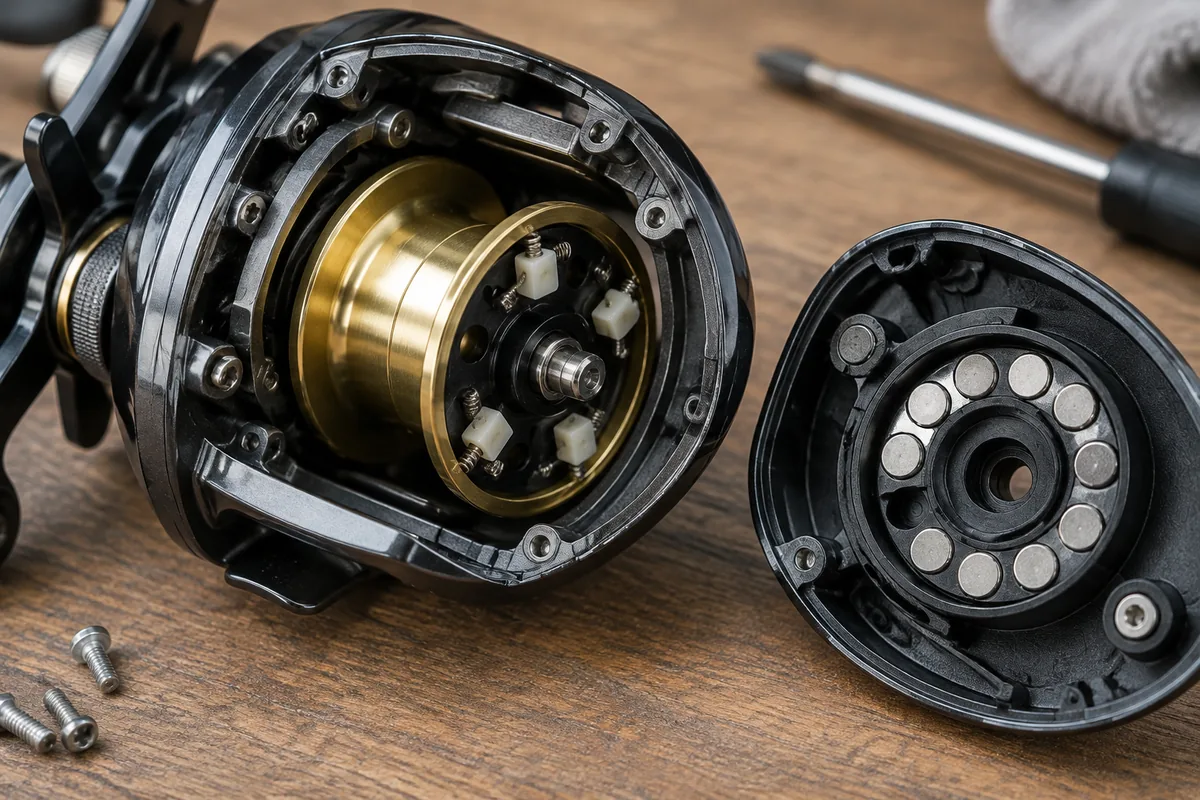
Magnetic brakes use magnets near the spool to create resistance. You adjust them with an external dial, so you can change the setting in seconds without opening the reel. The braking is smooth across the whole cast. That ease of adjustment makes magnetic brakes the friendliest choice for beginners.
Centrifugal braking
Centrifugal brakes use small pins or weights inside the spool that fly outward as it spins, pressing on a ring to slow it. They act hardest at the start of the cast, when the spool spins fastest, then ease off. That strong early control makes them great for casting into wind or throwing heavy lures. You adjust them by opening the side plate and turning pins on or off.
DC braking
DC braking, found on some premium reels, uses a tiny circuit to read spool speed and adjust braking automatically many times per second. It gives smooth, hands off control across conditions. You still set a level with a dial, but the system fine tunes itself. It is the most advanced and the most expensive.
Which Brake Suits You
| Brake | Adjust from | Best for | Found on |
|---|---|---|---|
| Magnetic | External dial | Beginners, easy tuning | Most reels |
| Centrifugal | Inside side plate | Wind, heavy lures | Many bass reels |
| Dual (both) | Dial plus pins | Widest tuning range | Mid to premium |
| DC | Dial, auto adjust | Hands off control | Premium reels |
For a first reel, magnetic braking is the easiest to learn, since you tune it from the outside. If you fish wind or heavy lures often, a centrifugal or dual system gives stronger early control. Many reels combine magnetic and centrifugal braking, which gives the widest tuning range and suits anglers who want to dial in every cast.
How to Set Any Brake
Start with the brake set fairly high, then set the spool tension so a lure falls slowly and stops when it lands. Make a few casts. If the reel backlashes, add brake. If casts fall short, reduce brake a little. As your thumb improves, you can lower the brake for more distance. On a dual system, use the centrifugal pins for the base setting and the magnetic dial for quick tweaks on the water.
Frequently asked questions
Which brake is best for beginners?
Magnetic braking. You adjust it from an external dial in seconds, and it brakes smoothly across the whole cast. That ease of tuning makes it the most forgiving choice while you learn thumb control.
Magnetic or centrifugal for wind?
Centrifugal, or a dual system. Centrifugal brakes act hardest at the start of the cast, when wind is most likely to cause a backlash. That strong early control makes them better for windy days and heavy lures.
What is a DC brake?
A DC brake uses a tiny circuit to read spool speed and adjust braking automatically many times per second. It gives smooth, hands off control across conditions. It is found on some premium reels and costs more.
Can you use both brakes together?
Yes. Many reels have a dual system with both magnetic and centrifugal braking. You set a base with the centrifugal pins inside the reel, then fine tune with the external magnetic dial. This gives the widest tuning range.
2 Comments